

The Promotion Paradox
Why do we take the person who’s best at the job and, the moment they’ve mastered it, promote them to a completely different one?
It’s something I have noticed recently in the Learning & Development sphere; a thread running through many management issues: we tend to promote the person who is doing the job the best.
Understandably, we promote the person we trust the most, the person who has evidenced their high performance, their intelligence and their expertise. The person who is great at their job. Why not?

As soon as you take a minute to think about this, the logic collapses. Why would we watch someone become extremely proficient in their role, only to wait until they’ve reached peak expertise to rip them away from this strength? Do we promote the greatest chef in the kitchen to take care of an entire restaurant, finances and all? No. And yet we make our best salesperson the sales manager, and then wonder why sales dip. So why do we promote technical experts into roles they have no experience in, and often no aspiration to be in anyway?
Why do we promote experts into roles they’re not equipped for?
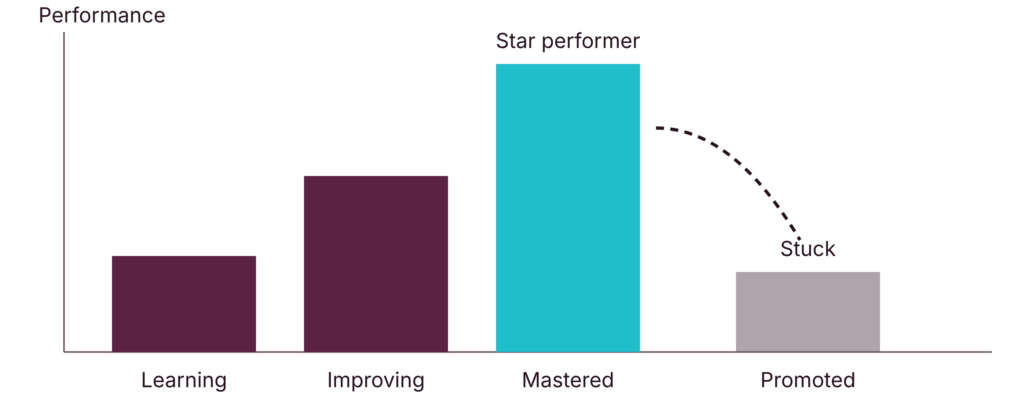
This is known as the Peter Principle (coined by Laurence J. Peter in 1969): we promote people for being good at their current job, until they land in one they’re not equipped for. You lose your star worker, and gain a manager who is trying their best, but who was only ever trained to be an expert in their role. Too often, they end up stuck: under performing and heading for burnout.
Being a technical expert does not automatically mean a person has management talents; management does not necessarily naturally follow excellent performance and output. That doesn’t mean our experts can’t become great managers (many do). But it won’t happen on its own. To be a great manager, you have to first get off the fence and decide you have management in your skill set.
Who should you promote into management?
Perhaps the employees who don’t shine quite as brightly in outputs and performance in their technical role are the exact employees who may have more to give in different areas. The person who isn’t the star of the shop floor could be the person who is great at managing shop-floor employees.
“Great performance should still count, but it shouldn’t be the only criteria for promotion.”

This is why behaviour is so crucial; notice if there’s someone in your team who isn’t your top performer, but has an uncanny ability to pull the team together, to motivate, to demonstrate emotional intelligence or to problem solve. These are often far more important to consider when deciding who you want to manage.

So, take a look at your managers. How many are managing because they wanted to, and how many because they were good at their original job?
The Reluctant Manager
Plenty of great managers never set out to be one. They were good at the job, so they were handed the team. We’re building a programme for exactly those people: the reluctant manager, who needs to decide whether management is for them, and how to do it well if it is.
It’s opening first to a small number of organisations. If you’d like to know more, follow us on LinkedIn, Facebook and Instagram, where we’ll share details as they land.
How many of your managers actually wanted the job?
If the answer worries you, let’s talk. DCo helps good people step into management with confidence.

Comfort Doesn’t Create Better Leaders
Neither does reading just one blog. Explore more articles that question conventional thinking and help build stronger leaders, teams, and cultures.